
Mumford said, ‘I named the bookshop The Absent Answer because it’s full of the unknown, and I find that beautiful.’
‘Yes,’ said Mieke.
‘But what we do know is beautiful too. Here’s Paul Davies.’
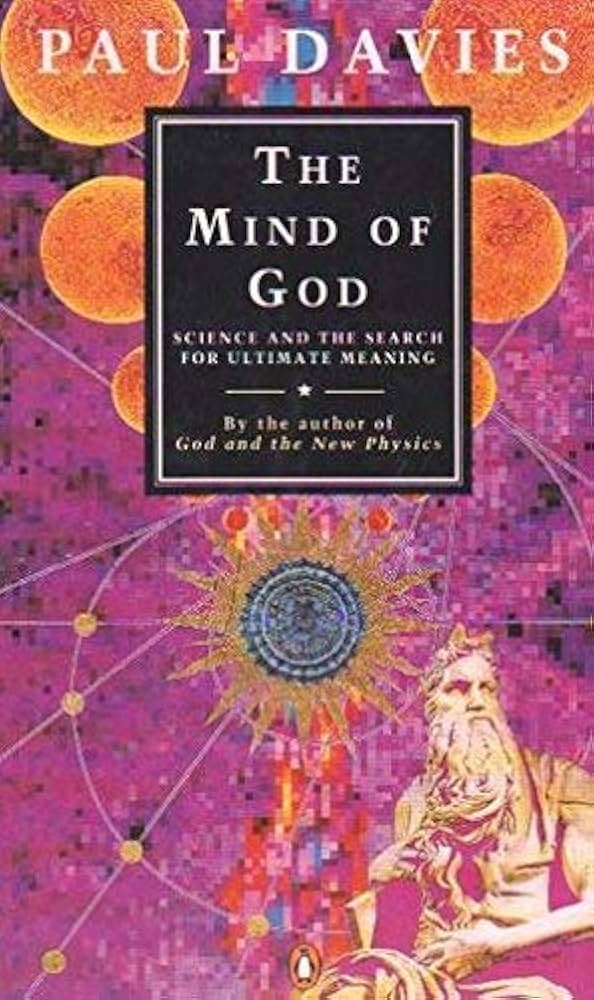
The success of the scientific method at unlocking the secrets of nature is… dazzling.
‘Here are some things we used to find miraculous, which science has now explained.’
Mumford read from a magazine:
The hue of the sky, the orbits of planets, the angle of the wake of a boat moving through a lake, the six-sided patterns of snowflakes, the weight of a flying bustard, the temperature of boiling water, the size of raindrops, the circular shape of the sun.
… All these phenomena … have been explained as necessary consequences of the fundamental laws of nature—laws discovered by human beings.’
‘That’s by Alan Lightman. He’s an American physicist, writing in Harpers.’

She looked up. ‘Do you see? We are surrounded by complex and glorious things – things which look mysterious – and yet, through them all there is a thread of rationality and order.
Mathematical laws that interweave each other to form a subtle and harmonious unity.
Paul Davies, p29
A Beguiling Idea
Mumford said, ‘In fact, we found so much order that at one point ambitious theoretical physicists began to dream of formulating a Theory of Everything – a complete description of the universe in terms of a finite set of laws.’
Mieke said, ‘Stephen Hawking talked about it.’
Mumford looked surprised. ‘Yes. And it’s a captivating idea, isn’t it? That the universe is one giant orderly clockwork system and that everything – from distant galaxies, to the shape of space, to black holes and dark matter, right down to little quarks – not to mention life and sunsets and time – all of it – it can all be completely described by a set of laws.’

It would mean:
The information needed to construct the past and future states of the world are folded into its present state.
Paul Davies, p29
‘If that were the case, you could dream up the universe and history and the future, all from logic alone.’
‘You’d know the mind of God,’ said Mieke.
Infinite ignorance
Mumford said, ‘Well the word God is a very loaded one. But yes, it’s a beautiful idea.
‘Unfortunately it turns out it isn’t possible, I mean even putting aside consciousness and … you know, daydreams … it isn’t possible even in physics.
‘I mean they are hoping string theory will bring together relativity and quantum physics. You need ten dimensional maths …’
‘Stop.’
‘Sorry. My point is, maybe it’s impossible anyway. Karl Popper was a British philosopher. He said,
Our knowledge can only be finite, while our ignorance must necessarily be infinite.
Karl Popper, 1960

‘For one thing, you get into an infinite regress. Matter is made up of atoms, and they’re made up of particles, which themselves are made of smaller entities…. But what does it mean to say a string of energy vibrates? What is energy?’
‘It’s the same with the logic of cause and effect. Take the universe. The laws of physics and logic can say what caused our planet and our solar system to be the way they are, and they can say what caused those things, and what caused those things, and they can trace the beginning of the universe back to a Big Bang event. But what caused that?’
‘Well if it was outside time, then cause doesn’t have any meaning.’
‘Exactly, at some point, we have to abandon meaning and resort to our imagination. And leave some things assumed, as accepted fact.’
‘Infinite regress, Godel,’ said Mieke. ‘And the Munchausen Trilemma.‘
Can rationality create itself?
Mumford said, ‘Exactly. The universe appears ordered and rational, but only up to a point. And when you really think about it, why should it be? Where do the laws of mathematics and logic come from?
‘Can rationality create itself?’
REFERENCES:
Davies, Paul (1992), The Mind of God. London, Penguin Books.
Einstein, Albert (1931), “The World as I See It”, Forum and Century, V 84, pp 193-4. LINK https://history.aip.org/exhibits/einstein/essay.htm
Included in Einstein, Albert (1935), The World As I See It, trans. A. Harris, London, John Lane The Bodley Head. Also included in Einstein, Albert (1954), Ideas and Opinions. New York, Crown Publishers.
Hawking, Stephen (1988) A Brief History of Time: From the big bang to black holes. New York, Bantam Books. LINK: https://en.wikipedia.org/wiki/A_Brief_History_of_Time
Lightman, Alan (2011), “The Accidental Universe: science’s crisis of faith”, Harpers Magazine December 2011 LINK https://harpers.org/archive/2011/12/the-accidental-universe/
Popper, Karl (1960), “Philosophical Lecture on the sources of knowledge and ignorance”, Proceedings of the British Academy, via the british academy.ac.uk
IMAGES: Featured image: “Circle of meaning” via Dreamstime
Cover of The Mind of God by Paul Davies published by Penguin 1992
Cover of Harpers Magazine, December 2011
Illustration for “Infinity Category Theory” by Eric Peterson via Scientific American
 The Absent Answer