
Mumford said, ‘So. You remember the Incompleteness Theorem.’
‘Yes.’
‘It’s not that logic is useless. Logic has given us … well civilisation. Medicine. Food for billions…’
‘Clearly.’
‘It’s just that you can’t take it too far. It has limitations.’
Mieke looked pained, ‘Yes. Godel. I don’t want to …’
Mumford put a colourful picture on the desk in front of her.
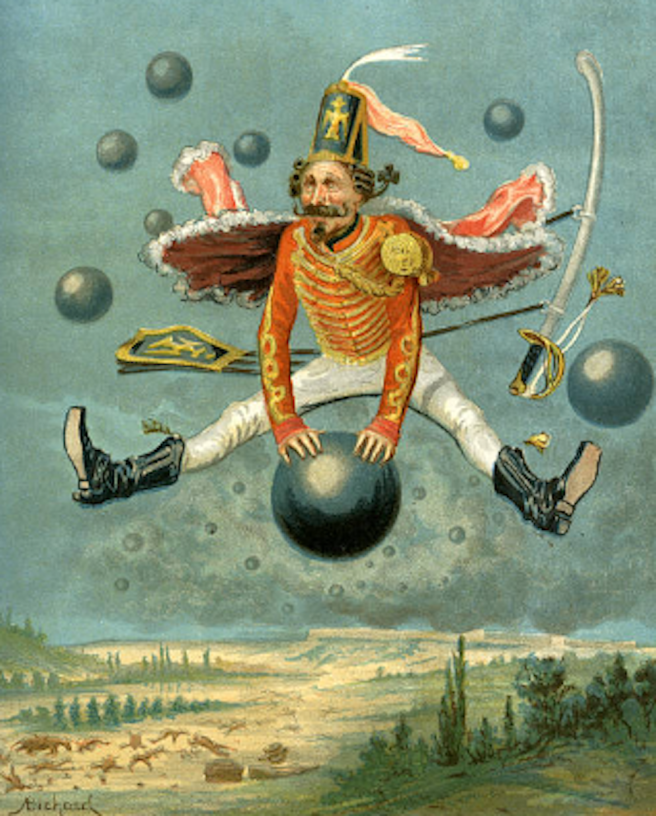
‘This is Baron Munchausen. He’s a character from some stories written in the eighteenth century.’
Mieke laughed, a little begrudgingly, but she looked interested now.
Mumford put down another picture.
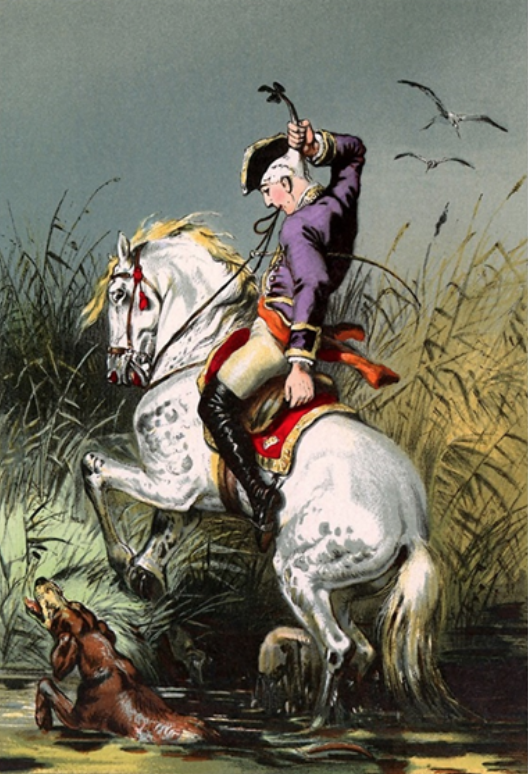
She waited a moment and said, ‘In this one he’s extricating himself and his horse from a bog, by pulling on his own hair.’
‘Yes I see. A failure of logic. Like pulling yourself up by your own bootstraps.’
‘Yes. Same idea.’
‘But good logical arguments don’t do that.’
‘No but only to a point. If you take it too far, logic always breaks down.’
‘Does it though?’
‘In fact in 1968, Hans Albert, a German philosopher, argued that it’s theoretically impossible to prove anything using logic. He described what he called The Munchausen Trilemma.’
Mieke sighed.
Mumford said, ‘When we try to prove something through deductive reasoning we always and necessarily fall into one of three traps.
She read:
Either…
ONE: We end in an endless regression, in which the proof relies on a more basic proof, which in turn relies on an even more basic one, and so on, infinitely.
Mieke said, ‘Like the turtles.’
‘Or:
TWO: There is in an infinite loop where our proofs lead us back to the place we started and we end up assuming what we want to prove.
‘Like Baron Munchausen’s pony tail.’
‘Yes. Or …’
THREE: We end up having to take something as given.
‘Like what … the laws of physics. … God?’
‘Heaven knows. Take your pick. The point is, logic will always fail in one of these ways.’
‘Does everyone agree with that?’
‘Oh you never get philosophers to all agree. There’s a whole field of epistemology which I find completely perplexing. I just thought it was an interesting idea.’
‘The Munchausen Trilemma.’ Mieke looked again at the picture.
Mumford said, ‘So whenever we try to prove something we have to start by taking something as given, or not start or end at all, as with infinite regress, or be a circular argument, justified only by itself.
‘I found a Youtube video of Albert himself in 1995, explaining it.’ Mumford waved the iPad.
‘Maybe later.’
‘It is pretty scratchy. Luckily for you I wrote down a quote.’
The classical idea consists in using a method to try to show that some beliefs are held … with absolute certainty…
(But) if you try to justify something as certain, then you either end up in an infinite regress, you have to justify the propositions or beliefs that are used in the justification and then you must further justify again, and so on, and there’s an infinite regress that can never be carried out.
Or you get into a logical circle, where something you want to justify is assumed at some point in this regress…
and finally what you can do is just break off at some point in the regress and say ‘this is certain’. But in practice this is a dogma.
REFERENCES:
The Muchausen Trilemma, Wikipedia.
“The Munchausen Trilemma” Hans Albert 1995 via Youtube.
Pigliucci, Massimo (2018), “Munchausen’s trilemma and the impossibility of certain truth” Footnotes to Plato.
Raspe, Rudolphe Eric (lived 1737 – 1794) The Surprising Adventures of Baron Munchausen. Gutenberg.
Raspe, Rudolphe Eric (1786 ) Baron Munchausen’s Narrative of his marvellous travels and campaigns in Russia . Google Books.
IMAGES:
‘Baron Munchausen’ by Oskar Herrfurth via wikipedia
‘Baron Munchausen’ via The Times
‘Baron Munchausen” via Speedwell Memos
 The Absent Answer
