
‘I want to talk about the turtles.’
Mumford put down her Paul Davies book. She picked up the iPad and tapped away, finding a website. Then she put it down.
Mieke hadn’t agreed to this but Mumford talked anyway.
‘Logic and science have brought us a long way, in understanding the universe and in making our lives comfortable. But they may never be able to explain everything in the physical universe.
‘One reason is that there are limitations to the fundamental nature of logic itself.
‘For one thing there’s a problem with what Paul Davies calls ‘the end of the explanatory chain.’
She picked up the Davies book again. Mieke sighed. Mumford read:
However successful our scientific explanations may be, they always have certain starting assumptions built in. … Sooner or later we are forced to accept something as given … logic or a set of laws, or some other foundation for existence.’
‘It’s sometimes called infinite regress. Everything has to be explained by something else. It never ends.’

‘It ends with God,’ said Mieke.
‘Well yes. For some people. But as Bertrand Russell said,
If everything must have a cause, then God must have a cause. If there can be anything without a cause, it may just as well be the world as God.
‘I completely disagree with that. I dispute the logic.’*
Mumford ignored her. ‘And if you don’t have a first cause, then you get a kind of never-ending pile of causation.’
‘The turtles,’ said Mieke. ‘Everyone knows this.’
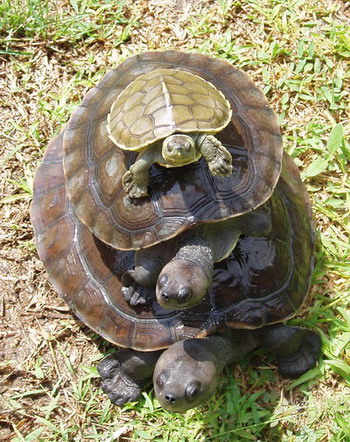
‘Let me read it anyway?’
Mieke sighed.
Mumford said, ‘There’s a version at the beginning of Stephen Hawking’s A Brief History of Time (1988). But this is my favourite version. It’s a story about William James.’

Mumford read from the iPad.
After a lecture on cosmology and the structure of the solar system, James was accosted by a little old lady.
“Your theory that the sun is the centre of the solar system, and the earth is a ball which rotates around it has a very convincing ring to it, Mr. James, but it’s wrong. I’ve got a better theory,” said the little old lady.
“And what is that, madam?” inquired James politely.
“That we live on a crust of earth which is on the back of a giant turtle.”
Not wishing to demolish this absurd little theory by bringing to bear the masses of scientific evidence he had at his command, James decided to gently dissuade his opponent by making her see some of the inadequacies of her position.
“If your theory is correct, madam,” he asked, “what does this turtle stand on?”
“You’re a very clever man, Mr. James, and that’s a very good question,” replied the little old lady, “but I have an answer to it. And it’s this: The first turtle stands on the back of a second, far larger, turtle, who stands directly under him.”
“But what does this second turtle stand on?” persisted James patiently.
To this, the little old lady crowed triumphantly,
“It’s no use, Mr. James—it’s turtles all the way down.”
*Mieke will tackle Bertrand Russell another day.
REFERENCES: Davies, Paul (1992), The Mind of God. London, Penguin Books. p 15.
Russell, Bertrand (1927), “Why I am Not a Christian”. Watts & Co., for the Rationalist Press Association Limited, 1927 First published as a pamphlet and reissued many times since then
Ross, J. R. (1967), Constraints on Variables in Syntax, 1967 PhD Thesis, Massachusetts Institute of Technology, published in Bloomington, Indiana, by Indiana University Linguistics Club.
IMAGES: “Infinity mirror effect” Elsamuko from Kiel, Germany via Wikimedia
“Turtles all the way down” By Pelf at wikipedia
Infinite regress via Wikipedia
John La Farge, Portrait of William James, 1859, via picryl.com
 The Absent Answer

