‘Here are some things that used to be miracles.’ Mumford held up a magazine. ‘It’s an article by Alan Lightman.’
Mumford read a passage.
‘‘… the hue of the sky, the orbits of planets, the angle of the wake of a boat moving through a lake, the six-sided patterns of snowflakes, the weight of a flying bustard, the temperature of boiling water, the size of raindrops, the circular shape of the sun.’
Mumford said, ‘We used to think things like this – beautiful amazing things – the sky and waves and stars – we used to think were just givens – miracles – created by God. They couldn’t be explained, and didn’t have to be explained. Now we have explanations for them in terms of laws.’
She read again:
The history of science can be viewed as the recasting of phenomena that were once thought to be accidents as phenomena that can be understood in terms of fundamental causes and principles.’

‘He means physics and mathematics.’
‘Yes. Physics and maths have laws and these were discovered by human beings. But that’s where the problem is. Do you see?
‘Not really.’
‘Why?’
‘Pardon?’
‘The question is why? Why should there be laws at all? We think we discovered them. They are some kind of given waiting for us to find. But where does mathematics come from?’
‘I’d never really thought about it.’
‘I found this on the Euresis website. It’s Paul Davies.’
’The founding assumption of science is that the physical universe is neither arbitrary nor absurd; it is not just a meaningless jumble of objects and phenomena haphazardly juxtaposed. Rather, there is a coherent scheme of things. … The existence of laws of nature is the starting point for science. But right at the outset we encounter an obvious and profound enigma: where do the laws of nature come from?’
Mumford said, ‘Why should the universe obey laws? Why should mathematics be the same everywhere for all time?’
‘And further … why there should be a creature capable of comprehending it.’
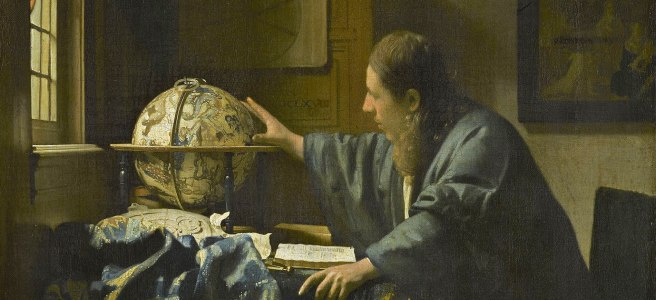
IMAGES: Johannes Vermeer, The Astronomer (1668) via wikimedia
Celestial Chart, Cavallini and Co jigsaw via Mindconnect Australia
 The Absent Answer
#/media/File:Johannes_Vermeer_-_The_Astronomer_-_1668.jpg)